Saturday, April 06, 2019

Tips & Tricks To Tracking Your German Russian Ancestors...Tip # 7 LEARN A NEW LANGUAGE...ANY LANGUAGE

Learn a new language...sunds a bit daunting, doesn't it? I think I can read your mind…you think you are too old to learn a new language…but hear me out...there are a lot of reasons why this tip is crucial to tracking your German Russian ancestors.


Many of the original records of your ancestors are written in a number of languages. And there will be times when you want to check the original records to verify your history.
Some original records will be in German and Russian, and when you add in South America, it can be a handy took to know Spanish, too.  Descendants of Germans from Russia relocated to countries around the world so any language skills are helpful.

Learning a new language doesn't happen overnight. And there are ways you can begin to learn by using tools to help you recognize key words found in records.  
Learning occurs over time and here are a few tools to help you ease into learning.


German English Genealogical Dictionary by Ernest Thode
German English Visual Bilingual Dictionary
For additional vocabulary list, see: Family Search
For an article on German language, including numbers, see:  Wiki German Language

Once you feel comfortable with a few words, you may want to take your language skills to the next level.  There are any number of options including:


As I mentioned earlier the thought of learning a new language can be overwhelming, however new evidence shows that our brain needs new challenges! We need to stretch our brain to increase its ability to grow and learn for the rest of our lives. Need proof? Check out the information about the plasticity of the brain and how to build your cognitive reserve at any age.


And, what better way to age well than to learn a language that will assist with tracking your ancestors. You never know, it may just help you when to implement Tip # 8 which is
TRAVEL HAS ITS OWN UNIQUE REWARDS.

©2019 Anna Dalhaimer Bartkowski

Sunday, March 31, 2019

Tips & Tricks to Tracking Your German Russia Ancestors...TRICKS!!!


Let's digress for a moment from the tips and talk about some tricks in German Russian genealogy which can confuse and confound the best of us.

Days, Dates and Calendars offer a unique challenge when looking at Russian records.  Here is an example that caused me concern for a few days. My grandfather, Fred Herzog, was born on July 4, 1882. His death certificate confirms this date. And,  my mother shared her memories of celebrating his birthday on the 4th of July, the same day the United States commemorates its independence with parades, picnics and fireworks.  The two events were tied together for her.


So when I received a Russian document showing his birth date as June 22, 1882, I thought I had information on the wrong Fred Herzog.

It took me a few days to remember the Calendar trick.  For a complete explanation of calendar changes, check out Adam Giesinger's article.  For a quick update, here is my take on it. The Julian Calendar was established by Julius Caesar.  Over years, the calendar fell behind the rotation of the earth around the sun.  After much debate and requests for a change, Pope Gregory XIII adopted a new calendar in 1582 which was subsequently called the Gregorian Calendar.  Catholic states adopted the new calendar immediately, but Protestant states and Russia adopted the Gregorian Calendar later. Ultimately it was Lenin who finally decreed in 1918 that February 1 would became February 14, thus bringing Russia's calendar in line with the rest of the world. So, any Russian documents before 1918 will not match Gregorian Calendar dates. I was delighted to realize this a few days later, and know that I indeed had a document that pertained to my grandfather.

If you receive a Russian document dated February 10, 1918...beware! And if you are lucky enough to track something in Europe back to October 10, 1582...challenge it!

The second tricky issue with tracking German Russian ancestry is names.  German naming conventions are repetitive at best and conflicting at worst.


Although not every family followed these style of naming their offspring, some did and it means that names are repeated each generation, both first names, middle names, and then there is the issue of nicknames.  Sometimes every son was named after their father, and was distinguished and called by their middle name...so in one family, you can have a father named Johann Christian, and his sons could be named Johann Christian, Johann Andreas, Johann Peter, Johann Phillip, Johann Heinrich, and so on.

Here is an example from the Jurks of Reinwald.  Below is a screen shot of a few of the Jurks names Johann Christian.  Of these ten, three were born within four years of each other which makes it very easy to pick the wrong one in your lineage.  And, they faithfully followed this naming pattern through generations. 


There are also over thirty-five different Heinrich Jurks in the Reinwald censuses.


And that doesn't include the nine Heinrich Jurks listed with their middle names! And there are examples of families who re-use the name of a deceased child for a newborn.  Yes, and I have seen it happen more than once. 

There are ways to keep your records straight as you work through your family tree and tips that can help you as work through years and years of Russian censuses. Each census builds upon the previous one.  The household numbers are an excellent guide to ensure you are tying back to the family you want. The census list includes the household number and the household number from the previous census.  Sometimes it matches, but often the numbers vary. Follow the household numbers and relationships carefully. Household movements are also well tracked in the notes so read it all. Check it one day, and if it seems illogical come back to it the next day. The key is to take your time...no need to rush through these records.  Being patient and reviewing your information will help you to get this right and make your family history records as accurate as possible.

Next up...more tips as we move to Tip # 7!

©2019 Anna Dalhaimer Bartkowski


Thursday, March 28, 2019

Tips & Tricks to Tracking Your German Russian Ancestors...Tip # 6 WITHOUT GEOGRAPHY, YOU’RE NOWHERE


Descendant of Germans from Russia are scattered around the world...North and South America, Australia, Europe, Russia and many more locations. And, there are many maps which can help you locate these settlements, and possibly locate your relatives.


Many of the books, organizations and other sources I mentioned in earlier tips have plenty of maps which are excellent resources. The book shown above, Emigration from Germany to Russia in Years, 1763-1862/With Maps by Karl Stumpp contains classic maps to introduce you to the movement of our ancestors.

Mitch Roll's Volga German map, while not drawn to scale, is helpful to see the layout of the villages. Alan Wambaugh's map of the same area adds a frame worth map to your collection. And, be sure to check out the map of Entre Rios, Argentina, just in case you travel there.

I have used all of these maps over the years, and recently there has been a big upgrade in our online map community.  Sandy Schilling Payne, who joined the group when I presented these tips and tricks at the SW Gilbert Regional Library in January, has created with a team the most efficient and thorough site for finding your ancestral village in Russia. (Be sure to check the latest edition of the Heritage Review and read Sandy's article on page 11 where she describes the value of community while she was there)


The Germans from Russia Settlement Location takes the deep dive into identifying by using Google Earth.  To quote the site:

 This is the home of the Google maps of the locations of German settlements in the Russian and Austrian empires that occurred from 1763 into the early 20th century. The locations are based on numerous historical maps, including those by Karl Stumpp, Rudolf Unterschütz, Pierre François Tardieu and others. This unique resource is detailed and vast in scope, inclusive of all German groups who uprooted from their Germanic homelands and heeded the call of Catherine the Great, her successors and others to colonize the forests and steppes of Russia and Austria.
This is a work in progress and a living document.
The Facebook site for German Russia Settlement Locations
Here's an example of my grandfather's village, Rosenfeld am Nachoi. Not only do you see the land through Google Earth and all of its perspectives, you also get all of the names the village had, the current name, latitude and longitude and more. There is a tutorial I highly recommend viewing.


Plan to spend a few quality hours at a minimum on this site.  It's an extraordinary site and I would be interested in your feedback.  What was your favorite features on these maps?  What did you discover about your villages that you didn't know before? Please leave your comments here or on facebook.

Coming up next, a few tricks to beware of  when you are on your genealogical journey.

©2019 Anna Dalhaimer Bartkowski

Friday, March 22, 2019

Tips & Tricks to Tracking Your German Russian Ancestors....Tip # 5...Community Counts...continued

As promised, Tip # 4 continues with examples of how being involved with the German Russian Community helps you make incredible genealogical discoveries.

It was tough for me to choose a few from the many discoveries I attribute to the community.  But here are two of my favorites.
My Mother and my Paternal Grandmother

This first story starts in my childhood, during visits with my grandmother who was very proud that her family, the Herrmanns and her husband's family, the Dalhaimers, descended from the original settlers in Mariental.  She also told us that her father-in-law told the story of the History of Mariental, but that my grandfather, who was very proud of his handwriting, wrote this story in a book. When we asked for a copy of the book, she said it was more like a pamphlet and she didn't have a copy.  Perhaps there was a copy somewhere in Russia?  She doubted it, she believed it must have been destroyed. 

At the AHSGR convention in Milwaukee in 2017, Mila Koretnikov was in attendance.  During one of her presentations, she mentioned that Nicholas Dalhaimer’s History of Mariental was available from the Engels Archive. I was shocked, and I had to reflect over and over to remember the conversation during the visits with my grandmother to remember the story she had mentioned. So I reached out to Mila for information, and she graciously helped me to purchase copies of the documents.
Cover of 1908
The History of Mariental from the Engels Archive

Nik. Thalheimer Marienthal
Sample Pages from The History of Mariental

While I can't prove this is my grandfather's writing, and it is only my memory of my Grandmother's story about the book, I have compared the writing to my grandfather's penmanship in the family Bible, and it a match for me.  The year of the publication matches the life span of my great-grandfather and grandfather.  And, my grandfather did not leave Russia until 1913, so he would have been there to record the history.  It's one of my treasures as I never knew either of these ancestors.


The second story occurred goes like this...
  • If I hadn't attended an Arizona Sun Chapter meeting in 2005...
  • I would have never met Judy Gareis
  • If I hadn't met Judy, I would not have been sitting next to her at the AHSGR Convention in Hays, Kansas listening to Isabel Kessler in 2007
  • And then Judy wouldn't have turned to me and said, "We need to go to Argentina."
  • To which I replied, "I'm not going to Argentina!"
To be continued under Tip # 8!

©2019 Anna Dalhaimer Bartkowski


Monday, March 18, 2019

Tips & Tricks to Tracking Your German Russian Ancestors....Tip # 5...Community Counts

Sometimes the best part of the genealogical journey is the people you meet along the way who share the family history bug.

I would never have learned as much as I do about German Russian history on my own as I did from  all of the great people who I have met. These people challenge my curiosity and help me answer the tough questions.

One of the best ways to find others who share your passion is through the national convention of two  groups I  mentioned earlier: the American Historical Society of Germans from Russia and the Germans from  Russia Heritage Society.

The American Historical Society of Germans from Russia convention will celebrate its Golden Jubilee this July. You will find a sense of community like no other.  The opportunity to attend the convention in Lincoln at the AHSGR headquarters offers ample chances to spend time in the full library and talk with experts who have decades of research experience. Besides attending conventions, becoming a member offers more benefits than I can explain here.


And, as long you are traveling during the summer, head further north for the Germans from Russia Heritage Society 49th Convention in Fargo, North Dakota. Same experience here, the community of people who gather will share the same drive to learn more about their ancestors.  It's like having a multitude of resources in one place.  Again, membership is a plus, especially when it comes to the resources on the web site.


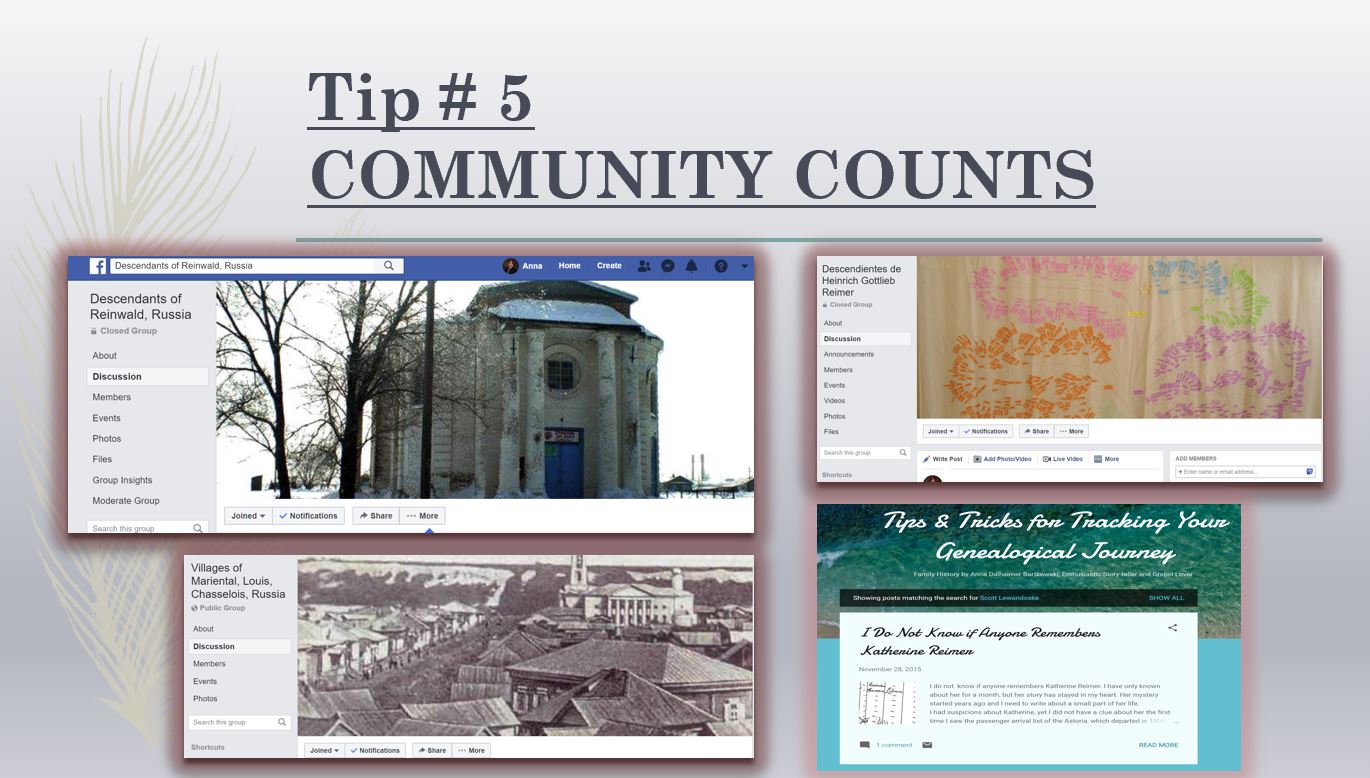
There are other communities, too, to consider. Social media makes it seem easy to ask simple questions like why did my German ancestors move to Russia?  My recommendation is to save your questions for  more in depth answers, not the ones for which answers are readily available on other sites. I found it is best on social media sites to focus your efforts by connecting to village coordinator/village pages. Here are a few links to some sites I found helpful or created.  If you can't find the type of site you want on social media, create it yourself, like I did with this blog.


Descendants of Reinwald, Russia (upper left corner)

Descendientes de Heinrich Gottlieb Reimer (upper right corner)

Villages of Mariental, Louis, Chasselois, Russia (lower left corner)

Tips and Tricks! (my own blog, lower right corner)

Tip # 4 will continue over to my next post where I share with you some personal discoveries I learned about due to the Germans from Russia Community.

Stay tuned!

©2019 Anna Dalhaimer Bartkowski


Saturday, March 16, 2019

Tips & Tricks to Tracking Your German Russia Ancestors...Tip # 4 KEEP CALM AND LEARN THE HISTORY

If you google Germans from Russia, you get over 24,400,000 results (in 0.55 seconds). That's an astronomical number of sites to cover to learn about our unique history.

If I were starting to learn my family's history now, I would read some of the fantastic books that analyze our history in depth.

While all of the sites I mentioned earlier as sources share some of the history of Germans from Russia, I believe that to get an in depth understanding, we need to read books.

These books below will help you learn the history of Russia, and better understand our ancestor's experiences. The books are non fiction and historical fiction, but all are based on facts. When you read, you learn the history, and you realize the impact of the then "current events" on your ancestors. This is what helps you create a portrait of what your ancestors were like and what issues impacted them. These books are:


  • From Catherine to Krushchev by Adam Giesenger
  • Catherine the Great by Robert K. Massie
  • Russka by Edward Rutherford
  • Nicholas &Alexandra Fall of the Romanov Dynasty by Robert K. Massie
Depending on when your family left Russia, some families may have been in the Americas longer than they lived in Russia. Those who left Russia in the 1870s have an entirely different history than those who left in the early 1900s. to those who stayed behind and may have been transported to Siberia.

Consider these three books to help you learn the history of Germans from Russia in America.


  • The Black Sea Germans in the Dakotas by George Rath
  • The Volga Germans, In Russia and the Americas from 1763 to the Present by Fred C. Koch
  • Second Hoeing by Hope William Sykes
One of the best books to read is the Origin, Development and Dissolution of the German Colonies on the Black Sea via the Example of Kandel, from 1808 to 1944.  This book tells the life of a colony in Russia, and although it specifically describes the village of Kandel, its story is the true story of every German from Russia colony. It was originally published by Landmanschaft der Deutschen aus Russland.  It was translated into English and published by the American Historical Society of Germans from Russia thanks to my friend, Tim Geiger. 


As you continue to KEEP CALM AND LEARN THE HISTORY, you never know what treasures you may find. You may just discover a connection to your own family in these books as I did.

While reading Wir Wollen Deutsche Bleiben The Story of the Volga Germans by George J. Walters, I found this passage about the settling of Balzer:
"On November 1765, George Merkel, a blacksmith, and Jacob Herzog, a farmer from Kurpfalx brought their families."
Jacob Herzog was my fifth great grandfather! So this book is now one of my favorites.

These books are a great start, and more books are published every year. As are the quarterly magazines from AHSGR and GRHS. These quarterly journals cover up to date information and will help you learn the history from all perspectives.


So, there are many ways to learn the history and make sense of what of our ancestors live. You'll be amazed how much you can learn.   Start today. 


Saturday, March 09, 2019

Tips & Tricks to Track Your German Russian Ancestors - Tip # 3 Sources, Sources,Sources..Continued

I bet you thought I forgot to update these tips!  No, not at all, it has been top of mind for me every day for nearly a month. However  as I mentioned in Tip #2, sometimes life gets in the way of the genealogical journey.  I followed my own advice of using a research log, so I knew exactly where I left off and we are still on Tip # 3!

Sources, sources, sources need to be reviewed as a series of posts, because there is so much information available to us now.  And it's simply easier to absorb all the details in bite size chunks. So without further delay, let's finish Tip # 3 Sources, Sources, Sources!


The Volga German Institute documents the cultural manifestation of the German speaking minortiy that lived along the Volga River from 1764 to 1941.  The links at the top of the site lead you to locations, surnames and biographies.

Under locations, villages are indexed alphabetically and each colonies' site gives you the inhabitants' surnames, and to where the families immigrated. The same is true under surnames so it is worth taking the time to check every surname to which you can trace your family line.

Be sure to check out the biographies link, like the sample below for the Reimer family.  Much of the family history is documented on this one site.  Could your family be part of the biographies? It's worth a few minutes to seek out the Biographies site as your family history may be right there.


Another site, the Germans from Russia Heritage Collection, was developed through the North Dakota State University Library. It 's a fabulous site to research and explore. it tracks not only the history of Germans from Russia, but provides extensive history of this group in the Dakotas. If any of your family lived in the Dakotas, this site must be searched.


The next two sites offer great value, and gives you the opportunity to learn how to translate websites into English.  The first, Geschichte der Detuschen aus Russland, is a site of choice for any of your relatives who repatriated from Russia or Kazakhstan to Germany.  I know my cousin in Germany regularly uses this site.  Note the pop up in the upper right corneron the screen shot below asking "Translate this page?"  Say yes to Translate!

The second site,  Centro Cultural Wolgadeutsch Argentina, is used by my cousins in Argentina.  You may think if your family was from a Lutheran village, it is unlikely that you have family in Argentina.  I thought that, too, but was proven wrong when I found my DNA cousin from the village of Protestante in Entre Rios. If you still doubt you have relatives in South America, I recommend you check out this site, because you could have relatives there just waiting to be discovered. And, it's not just descendants of the Volga region, Black Sea Germans from Russia also settled here. 

Well, that's a wrap on our fantastic sources. Thanks for staying with me as we worked through five different posts. Tip # 4 is up next! I'll be back soon.

©2019 Anna Dalhaimer Bartkowski


Sunday, February 10, 2019

Tips & Tricks to Track Your German Russian Ancestors...Tip # 3 Sources, Sources, Sources in Russia...Organizations & Societies

There are so many excellent sources from Organizations and Socities, it takes more than one post to cover the basics! Let take a look at the Germans from Russia Heritage Society next.


There is a vast amount of research available here.  You will want to explore the database and village groups. Village coordinators are organized by regions and area.  There is an alphabetical listing of Villages and Village Coordinators with who you will want to connect. The areas covered range from Beresan to Crimea to Kurchurga and Caucasus. Drill into all of the links to learn more and be sure to check out the letters which details much of the history of from the 1870s especially in the Dakotas, but including Canada and Argentina, too.


Another valuable all volunteer site is the Black Sea German Research. The Research Repository covers an incredible amount of information if your ancestors from the Black Sea Villages. There are so many links to visit, be sure to reseve at least a day to visit the whole site


And, if you doubted that descendents of Germans From Russia settled around the globe, just check  the number of languages in which this site is published. There are over 100 languages from which to choose!


There are at least four more essential sites to visit and we will cover it in the next post. Please stay tuned!

©2019 Anna Dalhaimer Bartkowski

Sunday, February 03, 2019

Tips & Tricks to Track Your German Russian Ancestors...Tip # 3 Sources, Sources, Sources in Russia...Organizations & Societies

Besides books, there are historical societies, organizations and individuals who have obtained records from Russia. All have excellent sources.  I can't cover everything each group has to offer, but here are highlights you won't want to miss.  Check out these focal points, but be sure to visit the entire website for additional outstanding information.

At the Center for Volga German Studies, there is a list of all of the Russian Censuses. The index listed below provides a Combined Surname Index to All Volumes compiled by Brent Mai.

And, then by village, there is a list of censuses that have been obtained, and who has the census.  Here are examples of 3 villages: Mariental, Rosenfeld am Nachoi and Rothammel.  This makes it easy to figure out how you can find a copy. New records are being published daily, however these volunteers do a great job of keeping up with many of the latest publications.


Every census provides great information, but if you can obtain an 1874 Family List (rewritten in 1896 with additional information), you have struck a gold mine of information. This time frame matches when many of our ancestors left Russia for the Americas, so this can help you build the link back to the original village settlers.

At the American Historical Society of Germans from Russia, there is plenty of good information...especially under the village and research links.

Under the village link you can read about your village history and connect with your village coordinator for the latest updates on your village's content.

As you drill into the research link, you can see from the drop down on the picture below that there are a multitude of options for continuing your search.  You will want to check all of the levels here, however, I wan to show you specifically the German Origins page.


Under the AHSGR German Origins Project is a wonderful compilation listed alphabetically by surname and village which links your family back to the place of Germanic origin. Here you might find your original settlers before you are able to connect directly by each generation through the census or other records. And, that's OK because sometimes you have to work from both ends of a situations to get to the middle!


I mentioned earlier that it will take a few posts to get through all of the sources we need to explore, and the organizations and societies postings will continue soon.

©2019 Anna Dalhaimer Bartkowski

Saturday, February 02, 2019

Tips & Tricks to Track Your German Russian Ancestors...Sources, Sources, Sources In Russia

Once you have exhausted all of the sources in the Americas, you are ready to reach out to sources in Russia.

How do you locate relevant resources in Russia?  You can obtain records directly for a fee. However,  unless you are fluent in Russian, the language can be a challenge.

The good news is that many documents have already been purchased from the Saratov and Engels archives.

So it is best to find out what has already been located, then supplement your records with purchases if needed. To discover what has been located, let's check out Books and Historical Societies.

There are five books I recommend to help you on your genealogical journey.

1) Emigration from Germany to Russia in Years, 1763 to 1862, with Maps by Karl Stumpp  (Pictured above)
This book is the guide to all of the emigrations from Germany to Russia and the maps alone are extraordinary.


2) Einwanderung in die Wolgageiet 1765-1767 by Igor Pleve
These four volumes list the movements to the Volga colonies, including most places of origin.  It is written in German and Russian, but with a little translation help, this is a valuable resource for all Volga Germans.


3)  The Immigration of German Coloniest to Denmark and Their Subsequent Immigration to Russia in the Years 1759-1766 by Dr. Alexander Eichorn and Dr Jacob  and Mary Eichhorn.
Without this book, I would have never learned about my 5th great grandfather, Johann Conrad Reimer. He was a tailor who traveled to Denmark with his wife, Johanna and two children, and his servant, seraching for greener pastures in Russia.  Unfortunately, he passed away in Denmark before he embarked on his travel. But, this informtion led me to my 6th great grandfather, Hans Georg Reimer, and my Reimer Germanic origins in Freudental.


4) 1798 Census of the German Colonies along the Volga, Economy, Population and Agriculture Volume 1 and 2, by Brent Alan Mai
These volumes are so helpful because the 1798 census helps us track many settlers who 
may have moved after they originally settled in a village, like my Herzog ancestors who settled in Balzer but moved to Reinwald before 1798.


5) German-Russian Handbook, A Reference Book for Russian German and German Russia History and Culutre, by Ulrich Mertens.
This book has so much information, I have not yet absorbed even a quarter of it!  However, it has fascination information, including citing the martyrdom of my friend Judy Gareis's relative. It's a comprehensive compilation of all of the villages and photographs and maps...nearly 800 pages of information.


These and many more research items are available for purchase or borrowing from private researchers.  Also, you can use the Interlibrary loan system to gain access to some of these books.

Our next source stop will be the organizations and historical societies who have additional, vast resources.

©2019 Anna Dalhaimer Bartkowski

Sunday, January 27, 2019

Tips & Tricks for Tracking Your German Russian Ancestors - Tip # 3 Sources, Sources, Sources...continued

Our goal is to find the Russian village from which our ancestors came.  If you need more help to track to who arrived first in the Americas, passenger lists can help.  While the list may or may not cite the actual village, it will tell you their last place of residence.


Any port can be a point of entry for our ancestors, but here are some of the most common ports with links to their records:


Once you have located your ancestor, be sure to read the names and origination point for all of the passengers.  Our ancestors traveled with neighbors, friends and relatives soother travelers may provide valuable hints for future research.  Keep that resource log close at hand!

Our next stop will be sources in Russia. Stay tuned.

©2019 Anna Dalhaimer Bartkowski

Monday, January 21, 2019

Tips & Tricks to Track Your German Russian Ancestors - Tip # 3 Sources, Sources,Sources

There are so many sources for tracking our ancestors that we will split this topic into a number of  posts, so we can adequately cover sources both  in the Americas and in Russia.

Depending on when your ancestors came to the Americas  you may find that they spent more time here than in Russia. The research in the Americas is critical to filling out your ancestor's
milestones so you can work through each generation, and ultimately determine the Russian villa which they came.


How do you locate the relevant resources in America?  Here are some important sites to visit and track in your research log. Click on the link to go directly to the sites.
Use your research log as you work through these sites.  Among the information you will discover include:
  • Newspaper, City Directories
  • US Federal Censuses, Land Records
  • Birth, Marriage & Death Certificates
  • Church Records
  • Military Records
  • Wills
  • Find A Grave
  • Naturalization Records which include port of arrival and birthplace
  • Draft Registration
  • Ancestry.com
  • Familysearch.org - which includes Obituaries of Germans from Russia collected by the American Historical Society of German from Russia
An example of what you might find from a newspaper is pictured above. It's an article about Phillip Reimer, my great grandfather, 85th Birthday celebration in 1939.  It details the name, age and residence of everyone who attended. One of my favorite lines is, "A chicken dinner was served to members of the family at the home of Mrs. Fred Herzog.

More Sources will follow soon!


©2019 Anna Dalhaimer Bartkowski

Saturday, January 19, 2019

Tips & Tricks to Track Your German Russian Ancestors - Tip # 2 - Choose Your Path

As you become a genealogy gatherer, you need to make a choice. How are you going to track your family history and research? It's a key decision.

There are plenty of software programs such as:

  • Legacy
  • Roots Magic
  • Family Tree Maker
  • Roots Web
  • Family Historian
  • Microsoft Excel
  • Ancestry
  • Family Search
Whatever your choice, tracking your progress is essential.  If you are like me, you start your research with passion, but then life gets in the way....and later, when you find a stretch of time, you wonder, "Where did I leave off? Where are all of the loose ends on which I wanted to follow up?

The syndrome, from which I suffer, is known as ADGD...that is

"Attention Deficit Genealogy Disorder... 
It's when you start researching one ancestor
which causes you to bounce around to different ancestors 
only to end up doing a lot of work with very little to show for it."      


If you want to suffer from ADGD, recognize it is a choice. But, there is a cure...and it goes beyond your choice of software.  I prefer to track my discoveries on a research log.  A research log is essential to organized success. I like the one shown above from my Legacy software. It's easy to use, you fill in the blanks, cite your sources, dates found, and add your follow up notes all on one form.

As you start to track your discoveries, slowly ou can build your family tree like the one below.


One word of warning, as you research,  you will see lots of family trees online.  Some are extremely well done, others not so. To build as accurate a family tree as possible, "Make sure you're doing the research and not just sticking anyone into your family tree."

Stay tuned for Tip # 3 coming soon. 

©2019 Anna Dalhaimer Bartkowski


Wednesday, January 16, 2019

Tips & Tricks To Track Your German Russian Ancestors - Tip # 1 - Start With You

As you start your genealogical research, you need to start to think of yourself as a genealogy gatherer. You need to gather everything you can to help build your family history. The goal is to record your own personal milestones to create a timeline of your life, then  your parent's lives, then your grandparents' lives and so on.

Use every tool possible...

  • Write down everything your remember,
  • make notes about the history of an heirloom, 
  • organize family recipes, 
  • consolidate photographs and home movies to help resurrect memories and build detailed milestones.

Be sure to:

  • Incorporate stories you have heard, things you believe,
  • Anything you can remember about you and your family. 
  • Include traditions and examples of what everyday life was like,
  • Add Stories you have heard that you may or may not be able to verify. 
It's best to do this over time as trying to do it in one sitting is too challenging. It's truly an adventure of your lifetime to assimilate these details to build a full family history.

Perhaps you can ask cousins, aunts, uncles...there is usually someone in the family who has taken on the role of family record keeper.  You need to find them and become their favorite relative!

Everything is a clue which can help you build the milestones. Some of the stories may include things you family didn't want to talk about...and that's ok. Everyone has some sad stories and we all have at least one black sheep in the family.  Some of the most interesting stories are there.  And, after reviewing some of these stories, if you aren't certain who is the black sheep of your family, perhaps you need to consider that it might be you!

Stay tuned, as Tip #2 will be coming soon.

©2019 Anna Dalhaimer Bartkowski
Tips & Tricks to Track Your German Russian Ancestors ©Tip

Tips & Tricks to Track Your German Russian Ancestors ©

Tips & Tricks to Track Your German Russian Ancestors ©

Sunday, January 13, 2019

Tip & Tricks Revisited...One By One...To Help You Track your Ancestors


Thanks to everyone who attended the "Tips and Tricks for Tracking Your German Russian Ancestors" yesterday at the Southeast Regional Gilbert Library.

Tracking family history ignites a passion to figure out who our ancestors were. And to understand their history requires curiosity, diligence and determination to uncover their story. As promised, I will update my blog with the tips and tricks over the next few weeks.

The "Tips & Tricks" sheet that was distributed yesterday provides you with a framework to build your family tree.  It lists all of the Tips, Tricks, website links, and books so you can search for clues for your family.  On this blog, we will revisit each point and also share the links to try to make your research a bit easier.

Before we dive into the Tips, lets review a proverb that defines what genealogy research is all about for me.


"Tell me the facts and I'll learn
Tell me the truth and I’ll believe.     
      But tell me a story and it will live in my heart forever.”
– Native American Proverb*
Along the way, we will find plenty of facts such as census records and passenger lists. Our journey will also include truth and beliefs, as recorded at that time. Most importantly our experience includes stories. I will share some of my German Russian family stories with you because, that's what brings our ancestry to life for me.  We'll start with Tip #1 in the next post.  See you then!


*Retrieved from https://elearningart.com/blog/elearning-quotes/. 


Sunday, November 25, 2018

Tips & Tricks to Track Your German Russian Ancestors


Join me in January as I share my tips & tricks, learned over 40 years of genealogical research, so you can break through brick walls of tracking ancestry of German settlers in the Russian Empire. I will help to demystify the history and offer ideas helpful to anyone tracing European ancestors and descendants around the globe. It’s a great opportunity to meet fellow German from Russia researchers, too!

Where: Gilbert Southeast Regional Library in the Shakespeare Room, 775 N. Greenfield Road, Gilbert, AZ 85234. (At the crossroads of Guadalupe and Greenfield, just west of the Riparian Reserve).
When: January 12, 2019 at 10:15 -11:30 a.m.
Register at the Library website (http://evanced.mcldaz.org/evanced/lib/eventcalendar.asp) after 12/17/2018

Dead Reckoning, New Web site, and New Blog

  Great News!  My latest book is now available.  Dead Reckoning is my attempt to share our heritage with the next generation. It’s about a ...